Publications.
Figure from the tabular representation study

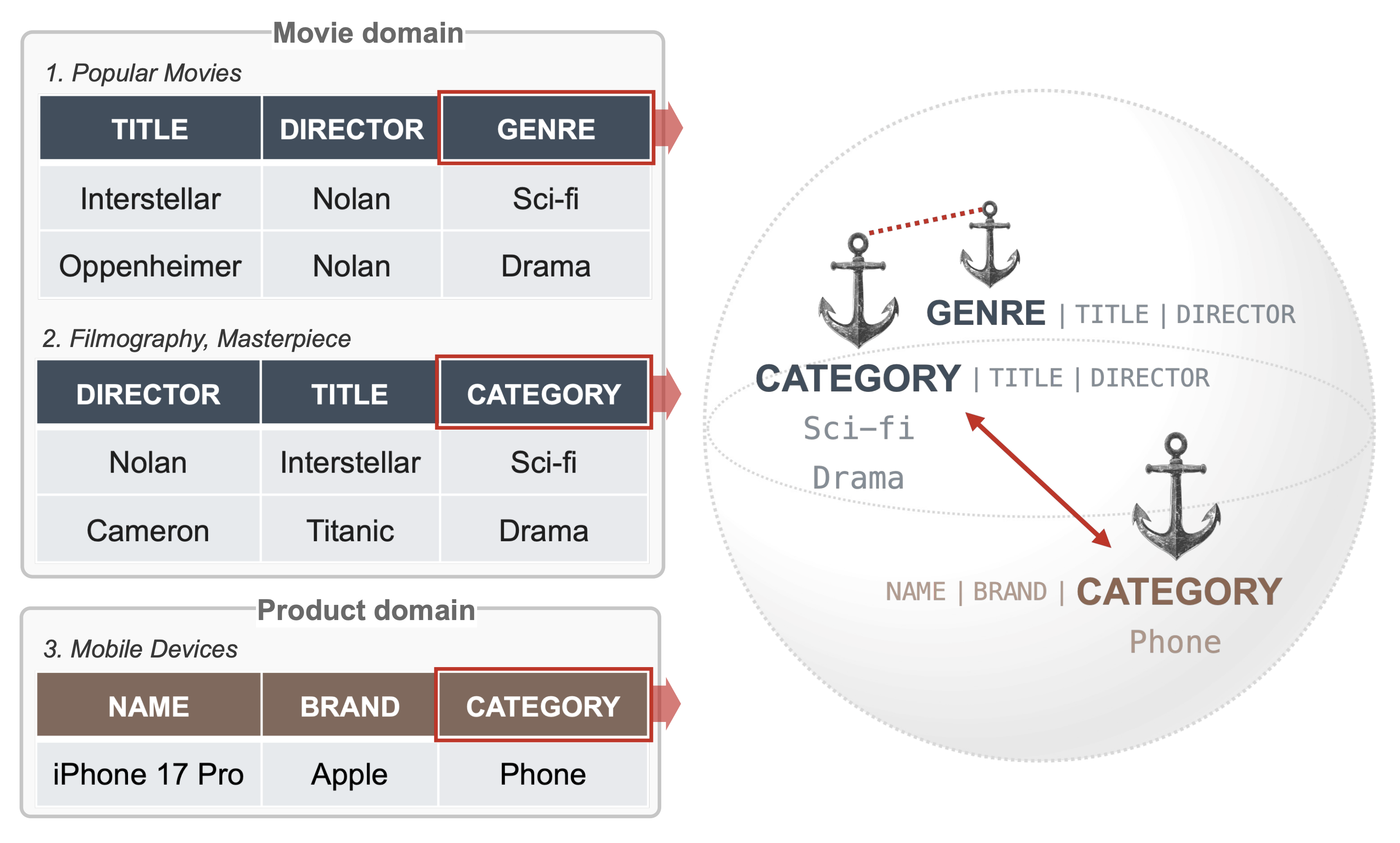
In real-world domains, many tables share similar vocabulary while representing different entities, relations, or operational contexts. NAVI therefore learns tables schema-wise rather than header-wise, modeling both the co-occurrence patterns among headers and the associated values. Grounding each table in this broader context helps the model infer what each table represents within a domain—and distinguish closely related tables.

ICML 26

Segment-driven Structural Induction and Semantic Alignment for Heterogeneous Tabular Representation

Woojun Jung, Susik Yoon

Figure from the massive document stream evaluation study

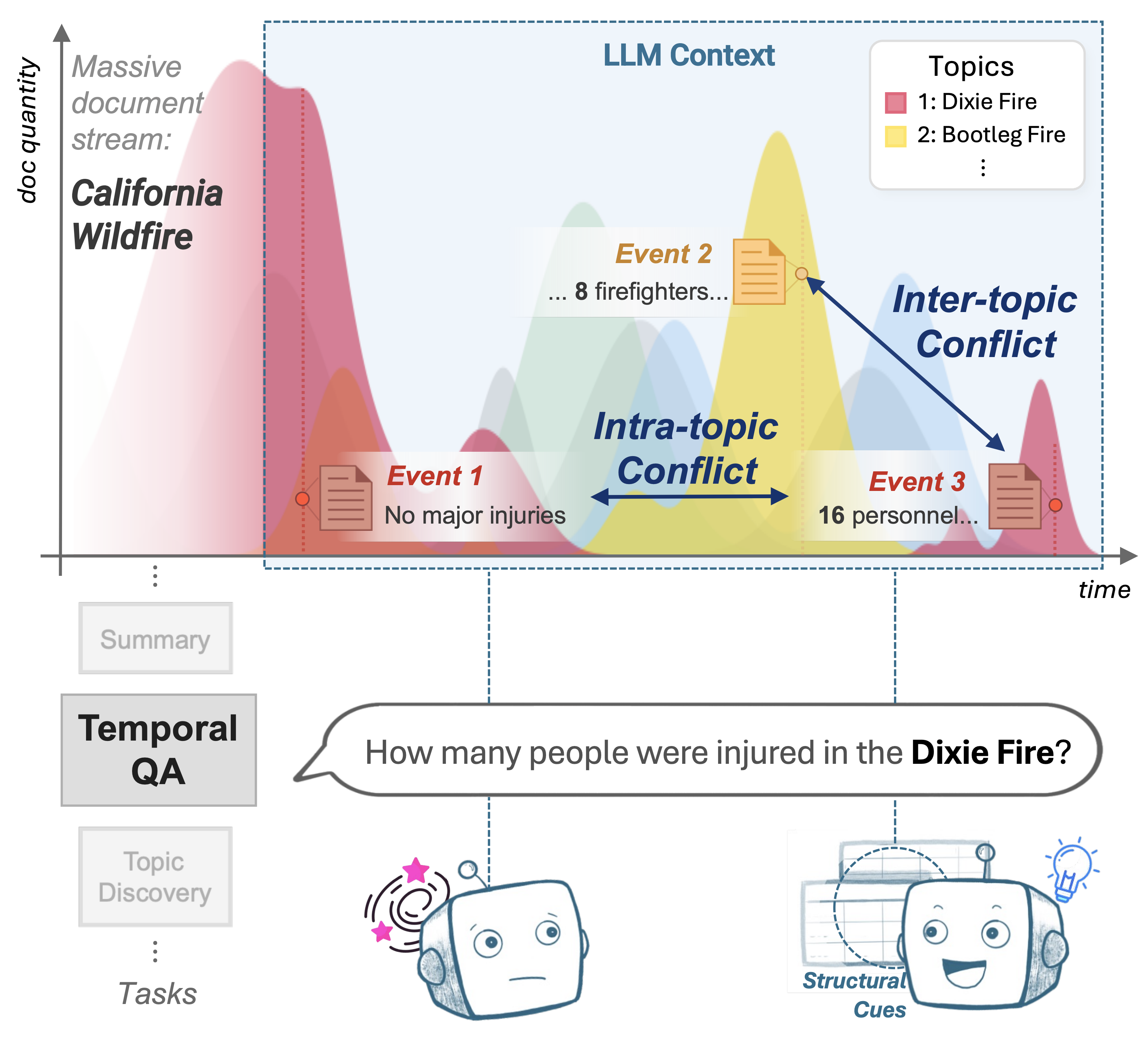
We ask whether structural cues let large language models reason over massive, continuously arriving document streams. Across temporal QA, summarization, and topic-discovery tasks over evolving real-world events, we measure where models lose the thread of context and how structural signals most reliably restore it.

KDD 26

Can Structural Cues Save LLMs? Evaluating Language Models in Massive Document Streams

Yukyung Lee, Yebin Lim*, Woojun Jung*, Wonjun Choi, Susik Yoon

Figure from the in-domain table pretraining study

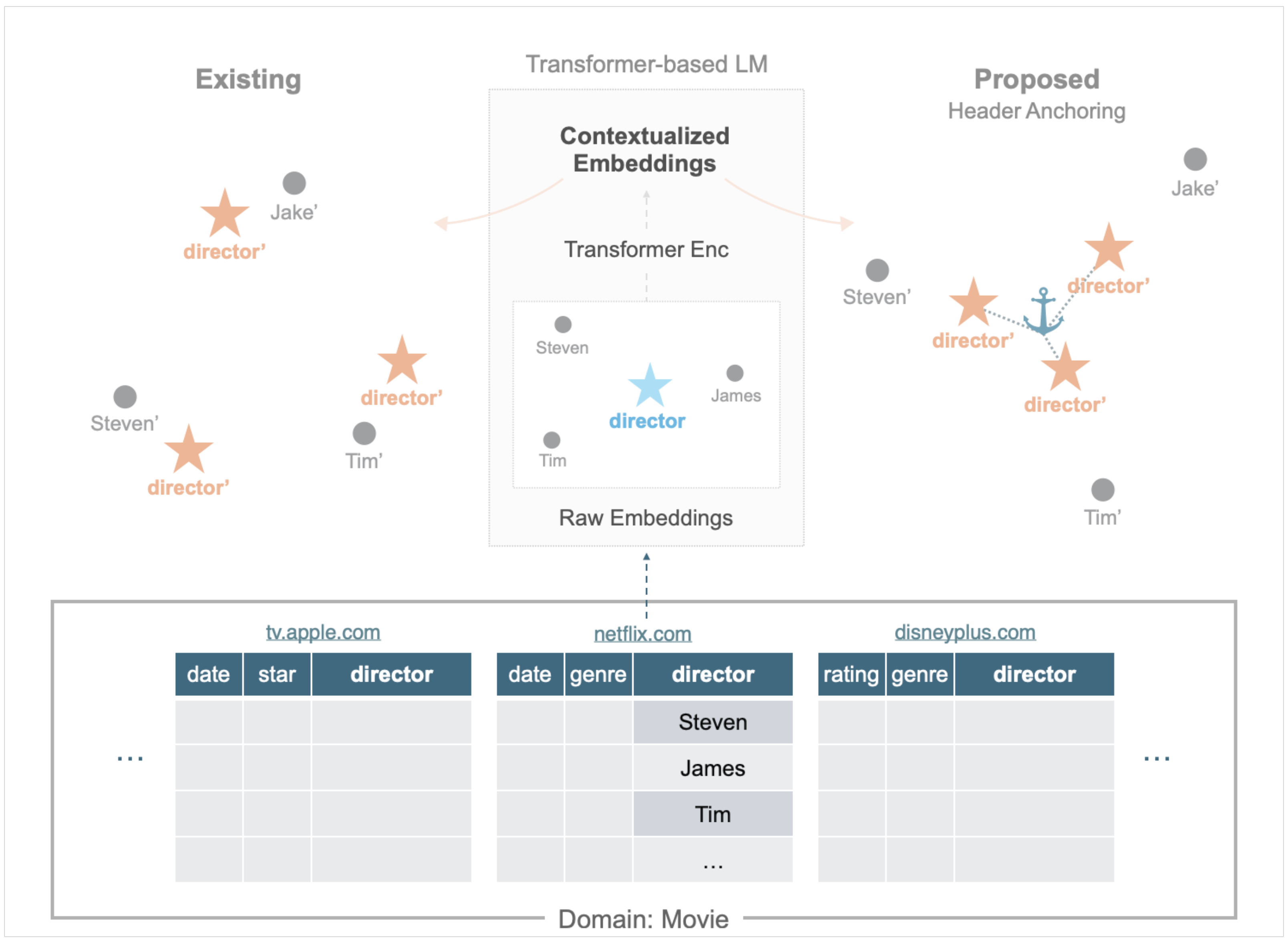
HAETAE explores how table schemas can serve as reusable carriers of implicit domain expertise. Column headers often express the concepts that organize a domain, but their representations can become unstable when tables are encoded row-wise. HAETAE introduces a separate encoder for schema elements and header-anchoring objectives that keeps header embeddings consistent across rows and tables.

SIGIR 25

HAETAE: In-domain Table Pretraining with Header Anchoring

Woojun Jung, Susik Yoon

Questions I keep returning to.

World Understanding — Can machines make sense of the world as humans do?

Aligning human and machine perception feels foundational to me. Machines that perceive the world more like we do can better interpret context, intention, and meaning.

For me, this question first became concrete through tables. Decades of human knowledge—scientific records, medical data, institutional logic—are encoded in tabular form, often carrying implicit domain expertise that is difficult for machines to recover. How can we make that knowledge legible to AI? This question led to my work on HAETAE (SIGIR 25) and NAVI (ICML 26).

More broadly, humans make sense of the world by combining sensory experience with accumulated knowledge. We integrate sight, sound, touch, taste, and smell, then interpret them through concepts, memories, and shared systems of meaning. I am interested in how machines can connect these heterogeneous signals into coherent representations of the world.

At its core, I want machines to recognize what we recognize, infer what we infer, and work with the knowledge we carry.

Human Understanding — Can machines understand what lives between people?

Where world understanding asks whether machines can interpret the reality around us, human understanding asks whether they can interpret the realities that exist within and between people. Much of what shapes how we think, feel, and communicate is never stated directly: personal memories, routines, preferences, emotional states, cultural references, and the shared context built over time within families, communities, and relationships.

These aspects of human life are not easily captured as a fixed set of semantic labels. They are distributed across behavior, language, history, and relationships—felt rather than fully articulated. I am interested in how AI systems might recognize these implicit patterns.

This leads me to two connected directions. One is lifelong hyper-personalization: small, on-device models that grow alongside a person, gradually building context through an ongoing relationship rather than relying on a static profile. The other is how pluralistic large models can transfer their understanding of communities, cultures, and social perspectives into personal models. A personal AI should be grounded in the individual it serves, while still retaining an awareness of the wider social worlds that shape that person’s life.

I am interested in AI as a system that learns the evolving context of a particular person while remaining open to the diversity of people around them.

Human Augmentation — Can machines help us understand what they understand?

The first two questions ask what machines should learn about the world and about people. This one asks how that understanding should return to us. A model may recognize a pattern in a medical record, infer a hidden relationship in data, or adapt to the context of a particular person—but none of that matters unless it can become understandable, usable, and appropriately timed.

I am interested in the translation layer between machine representations and human experience. What should be surfaced, and what should remain in the background? When is a number enough, when is an explanation needed, and when might an interface, visualization, gesture, or ambient cue communicate more effectively? The answer depends not only on what the system knows, but on what a person needs in that moment.

In this sense, human augmentation is not simply about exposing what a model sees. It is about composing a shared perceptual space: one where machine understanding can support people’s judgment, communication, and connection without overwhelming or replacing them. This is not a question models alone can answer—it requires prototypes, interfaces, and people to test them with.